Now that you have found a storage facility and unit that meets your needs, it’s time to sign the papers. As you review the agreement between you and your chosen storage facility, you should understand what is expected of you as a tenant.
One common responsibility is ensuring you are covered if your storage unit experiences issues such as flooding, theft, or other circumstances beyond your control.
Storage unit insurance is available for anyone looking to protect the personal items in their unit – especially when valuables or high-priced items are present. Renters insurance and homeowners insurance often extend coverage to your storage unit; however, every policy differs in how much coverage it offers. Storage unit insurance is often an affordable option that offers more coverage.
So, how much does it cost to insure a storage unit? Here’s the short answer: storage unit insurance usually runs somewhere between $8 and $50 a month, depending on how much coverage you need.
Let’s break down what actually drives the cost, what a typical policy covers, and how to find the right fit for your storage solution without overpaying.
Do You Actually Need Storage Insurance?
Most self storage facilities require some form of insurance or protection plan as a condition of your rental agreement. That doesn’t mean you have to buy a new policy, though. It just means you need some coverage on the books before you move in.
You typically have three ways to check that box:
- Your existing homeowners or renters insurance may already extend to items in storage
- A facility-offered protection plan, added to your monthly rent
- A standalone third-party storage insurance policy, purchased separately
What Affects the Cost of Storage Unit Insurance
Here’s the part that surprises a lot of renters: your unit size isn’t really what sets your insurance price. What matters most is how much your stuff is worth.
The main factors that actually move the price:
- Coverage amount — how much your stored belongings are worth, and how much you want reimbursed if something happens
- Deductible — lower or $0 deductibles usually mean a slightly higher monthly premium
- Coverage type — actual cash value (depreciated value) is cheaper than Replacement Cost (what it’d cost to buy new)
- Provider type — facility plans, third-party insurers, and home insurance riders are all priced differently
- Location — rates can vary a bit by state and even by ZIP code
A studio’s worth of boxes and furniture might only need $2,000–$5,000 in coverage, while a garage or an entire household in storage could require $10,000–$25,000 or more. That’s the real reason bigger units tend to come with bigger premiums.
Typical Price Ranges for Storage Insurance
Since every renter’s situation is different, it’s more useful to think in ranges than in one flat
number. Here’s a few monthly price ranges you can expect:
- Small unit: $8-$15/month
- Medium unit: $12-$15/month
- Large unit $25/$50/month
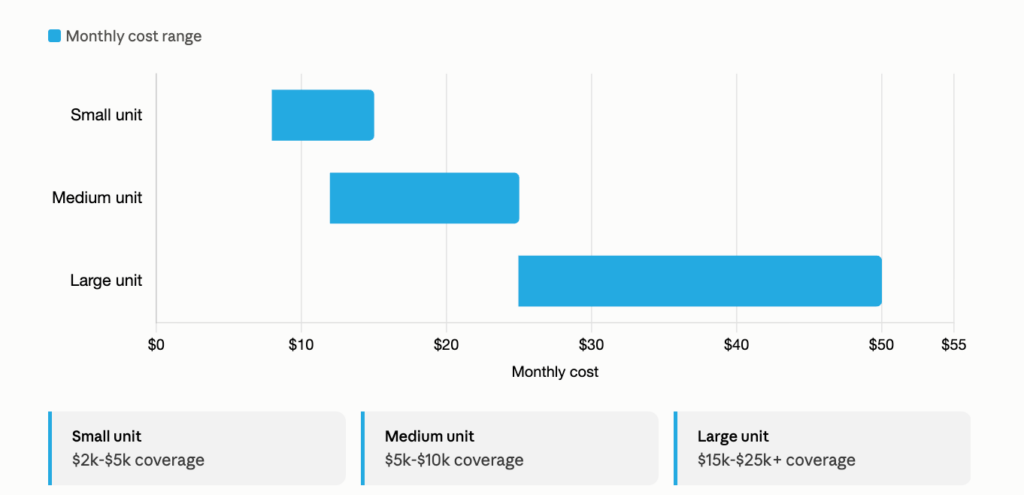
Facility-provided protection plans tend to fall at the lower end of these ranges and have lower coverage caps. Standalone third-party policies can stretch much higher; some go up to $75,000 in coverage for renters with especially valuable items.
Since pricing varies by provider and location, it’s always worth asking your storage facility directly about the cost of their protection plan.
What’s Covered vs. What’s Not
Like any insurance policy, storage coverage protects against specific causes of damage or loss and excludes others. Knowing the difference now can save you a headache later.
Typically covered:
- Fire, smoke, and lightning damage
- Wind and hail damage
- Water damage from leaks or burst pipes
- Vandalism and break-ins (usually with proof of forced entry)
- Building collapse or explosion
Commonly excluded (or limited):
- Flood or rising water damage
- Earthquake damage
- Mold and mildew
- Pests or vermin damage
- Theft without signs of forced entry
- High-value items like jewelry, fine art, or cash (often need to be listed separately)
If you’re storing anything particularly valuable or irreplaceable, ask your provider whether it needs its own line-item coverage; most standard policies cap payouts on these categories pretty low.
Three Storage Insurance Options
1. Check Your Homeowners or Renters Policy First
Many homeowners and renters policies already include “off-premises” coverage, often around 10% of your total personal property limit. If your policy covers $50,000 in belongings, that could mean roughly $5,000 available for items in storage — potentially at no extra monthly cost. It’s worth a quick call to your insurance agent before buying anything new.
2. Add a Facility Protection Plan
The simplest option is usually the plan offered right at your storage facility. It’s added to your monthly bill, kicks in immediately, and is easy to adjust or cancel. The trade-off is a lower coverage ceiling and a shorter list of what’s protected.
3. Buy a Standalone Storage Insurance Policy
If you’re storing higher-value items or planning to store long-term, an independent storage insurance provider can offer significantly higher coverage limits.
Tips to Keep Your Storage Insurance Costs Down
- Only insure what you’re actually storing.
- Check your existing policy before adding a new one.
- Choose a higher deductible if you can. A slightly higher deductible often lowers your monthly premium.
- Reassess coverage if your unit’s contents change.
- Ask about bundling. Some facilities offer a discount when protection plans are added at move-in.
FAQ: Storage Unit Insurance
- Is storage insurance required? Most facilities require some form of coverage, but you can usually satisfy that requirement with your existing homeowners or renters policy instead of purchasing a new plan.
- Does storage insurance cover flooding or pest damage? Usually not. Flood, mold, and pest damage are commonly excluded from standard storage insurance policies, so ask about add-on coverage if these are concerns in your area.
Looking for the Right Storage Unit? Urban Storage Can Help
Figuring out the right amount of coverage is a lot easier once you know what you’re actually storing and the size of your storage space. Our staff across Urban Storage locations can help answer questions about protection plans and pricing.
Find an Urban Storage location near you in Washington, Oregon, New Mexico, Hawaii and Arizona.

